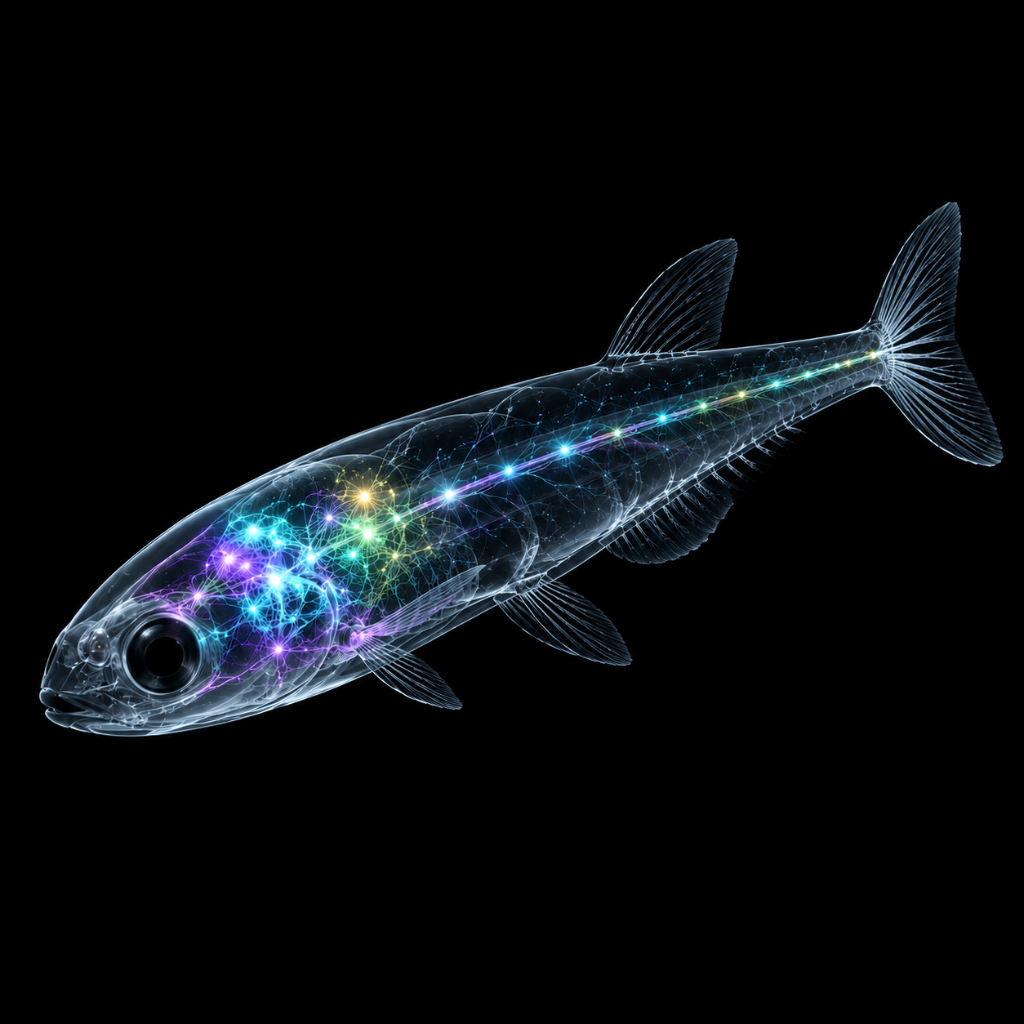
Scientific Validation & Epistemic Charter
Rigorous neuroanatomical grounding for Danionella cerebrum. All structural coordinates, cell allocations, and biophysical properties are empirically anchored to primary literature and validated through closed-loop biophysical simulation.
Epistemic Classification Standard
Stereotaxic coordinates, 3D lobular volumes, dominant neurotransmitter phenotypes, and macro-tract connectivity derived directly from the Charité Berlin reference template (dc_mixed_hhg6@1.0).
Volume-constrained cellular point allocation distributed across the 203 empirical nuclei respecting cranial density bounds ($1.08 \times 10^6\text{ cells/mm}^3$).
Leaky Integrate-and-Fire ODEs executing at 50 Hz with chemical neurotransmitter conductances, dynamic synaptic delays, and carangiform motor pattern generation.
Mathematical Biophysics & Governing ODEs
The membrane potential $V_m(t)$ of each neuron in the 650,000 population evolves according to:
if V_m ≥ V_th ⟹ Action Potential Spike fired; V_m ← V_reset for refractory period τ_ref
Synaptic currents decay as a double-exponential alpha function:
where E_rev = 0 mV for AMPA/Glutamate, -75 mV for GABA_A, and -70 mV for Glycine.
Peer-Reviewed Literature & References
-
Judkewitz Lab, Charité – Universitätsmedizin Berlin (2026).
A whole-brain anatomical atlas and projective connectome of adult Danionella cerebrum.
bioRxiv preprint. DOI: 10.64898/2026.03.09.710483v1. Template version: dc_mixed_hhg6@1.0. -
Britz, R., Conway, K. W., & Rüber, L. (2021).
The simplest vertebrate brain: Danionella cerebrum, a new species of miniature cyprinid fish from Myanmar.
Scientific Reports, 11, 19138. -
Cook, P. H., et al. (2024).
Ultrafast acoustic communication mechanisms in miniature teleosts: 140 dB sonic organ architecture.
PNAS, 121(10), e2314015121.